open62541 / UA SDK feature parity
Author: Paris Moschovakos
Date: June 2026
Support: quasar-developers@cern.ch
Overview
A quasar server can be built against either OPC UA back-end: the commercial Unified Automation C++ SDK (UA SDK), or the free and open-source open62541, reached through the open62541-compat compatibility layer. Feature parity means that the same quasar server, compiled against open62541-compat, behaves identically to the one compiled against the UA SDK: the same OPC UA address space, the same node ids, browse names, references, data types, access levels and timestamps, and the same results from read, write and method-call operations.
Parity is an engineering property of the compatibility layer, not a claim. It was verified across the full set of production servers by building each server twice – once per back-end – and comparing, between the two builds, the served address space node-for-node and the outcomes of read, write and method calls. The served address spaces and the operation results match. This document records what open62541-compat had to implement to reach that point, organised by the two areas where the back-ends used to diverge: observable address-space and type fidelity, and asynchronous I/O.
The work spans open62541-compat 1.5.0 through 1.5.7. The 1.5 port moves the bundled stack to open62541 1.5.4 and is anchored by asynchronous read/write/call completion – the feature that motivated the port and that closes the last behavioural gap against the UA SDK.
Behavioural and address-space fidelity
The UA SDK fixes a set of observable behaviours – status-code names, node-id string formats, property namespaces and access levels, type semantics, timestamps – that quasar servers and their clients depend on. open62541-compat now matches each of them. Most of these were latent divergences that surfaced as production incidents: regex parsers segfaulting on the wrong node-id shape, address-space walks counting nodes multiple times, properties served with the wrong namespace or write access. The table below lists the parity items; each is verified against UA SDK 1.6.5 headers and carries a regression test.
Parity item |
UA SDK behaviour, now matched |
|---|---|
Status-code aliases |
Effectively the full |
Node-id string format |
|
Property browse-name namespace |
A property under ns2 browses as |
Property access level |
The access level passed to the |
ByteString semantics |
|
Empty/null typed values |
An empty 1-D array stays an array, not a scalar or null
( |
Server status |
|
hvsys-class API surface |
A verified subset of the broad UA SDK surface that hvsys-class servers
compile against: |
Timestamp order |
|
Single reference registration |
Each node’s reference list is populated once. The compat layer stopped
duplicating |
Asynchronous I/O
This is the central piece of the parity work. Under the UA SDK a device read, write or method body can complete off the stack thread and be delivered later; the bundled open62541 could not. open62541-compat now provides the same contract: slow device I/O no longer stalls every session, subscription and publish on the endpoint, because the operation is deferred off the single EventLoop thread and completed when the device returns.
The open62541 1.5 enabler
The mechanism only exists in open62541 1.5. The bundled stack is now
open62541 v1.5.4, amalgamated with -DUA_MULTITHREADING=100 (baked in at
amalgamation time). 1.5 introduces per-invocation deferral: a DataSource or
method callback returns UA_STATUSCODE_GOODCOMPLETESASYNCHRONOUSLY and the
result is posted later through three thread-safe completion functions –
UA_Server_setAsyncReadResult, UA_Server_setAsyncWriteResult,
UA_Server_setAsyncCallMethodResult – with cancellation delivered through
the config’s asyncOperationCancelCallback. The pre-1.5 bundle could not
defer read or write at all: only CALL existed in the async enum, READ and
WRITE were commented-out placeholders, and the completion functions did not
exist in usable form, so a callback had to fill the result before returning.
UA_MULTITHREADING >= 100 is the precondition for calling the completion
functions safely.
The deferral seam
Deferral is opt-in on OpcUa::BaseDataVariableType and default-off, so
cache variables keep their synchronous fast path (no async block, no
handshake). The seam is three virtuals:
virtual OpcUa_Boolean handlesIo() const { return OpcUa_False; }
virtual void beginRead(AsyncReadHandle handle) { handle.complete(value(nullptr)); }
virtual void beginWrite(const UaDataValue& dataValue, AsyncWriteHandle handle)
    { handle.complete(setValue(nullptr, dataValue, OpcUa_True)); }
The default beginRead/beginWrite complete inline immediately. A
subclass that returns handlesIo() == true and dispatches the handle to a
worker thread gets deferral. Methods do not use this seam: unifiedCall
always allocates a block and hands it to the receiver’s beginCall as the
MethodManagerCallback.
The operation block and the two-phase handshake
One primitive serves all three operations. An AsyncOperationBlock (heap,
shared_ptr-owned) carries the back-pointer to AsyncOperations, the
stack’s identifying pointer as the key (the UA_DataValue* target for a
read, the const UA_DataValue* for a write, the UA_Variant* output array
for a call), the payload slot, and a single-word std::atomic<int> phase
with Phase { Initial=0, Finished=1, Deferred=2 }.
Completion is a release/acquire handshake on that atomic that guarantees
exactly one completer on every interleaving – including the race where the
worker finishes before the glue regains control. The completing side stores
the payload then exchange(Finished); if the prior value was Deferred
it pushes the block to the completion queue. The glue side, after begin*,
does exchange(Deferred): if the prior value was Finished it consumes
the result inline and returns the operation’s result (GOOD for a successful
read); otherwise it registers the block and returns
GOODCOMPLETESASYNCHRONOUSLY.
if (variable->handlesIo() && operations && operations->deferralActive())
{
    std::shared_ptr<AsyncReadBlock> block = std::make_shared<AsyncReadBlock>(operations, dataValue);
    variable->beginRead(AsyncReadHandle(block));
    if (block->phase().exchange(AsyncOperationBlock::Deferred) == AsyncOperationBlock::Finished)
    {
        block->finishInline();
        return UA_STATUSCODE_GOOD;
    }
    operations->establishDeferral(block);
    return UA_STATUSCODE_GOODCOMPLETESASYNCHRONOUSLY;
}
The read/write handle destructors complete with OpcUa_BadInternalError if
dropped without complete(), so a misbehaving subclass cannot leave the
stack waiting forever. Method output copy is bounded by min(stored, arity)
to stay in range for throwing methods.
The completion transport and EventLoop drain
Workers never touch the stack. The only worker-side action is push() onto a
compat-owned completion queue (a mutex plus a vector); push() appends the
block, decrements the inflight counter, and notifies a condition variable. The
actual completion – the result-memory write plus the
UA_Server_setAsync*Result call – happens in drain(), which runs on
the EventLoop thread, where it is serialised with cancellation by
construction.
Drain runs at two points: between UA_Server_run_iterate calls in the run
thread, and from a 20 ms repeated server callback. Calling the completion
functions from inside the repeated callback is legal because the server locks
are reentrant. Deferred-completion latency is therefore bounded by one drain
period (<= 20 ms) on an otherwise idle server. Per-server reach is via
config->context, which holds the AsyncOperations instance.
Cancellation and the ABA guard
Cancellation arrives through the config’s asyncOperationCancelCallback;
cancel() erases the registry entry by key and touches nothing else. There
is an ABA hazard: after cancellation the stack may reuse the same key pointer
for a new operation, so a key match alone is insufficient. drain()
therefore completes an entry only when the key is present and the
registered block is the same object:
for (auto& block : batch)
{
    auto it = m_pending.find(block->key());
    if (it == m_pending.end() || it->second != block)
    {
        LOG(Log::INF) << "Dropping completion of a cancelled asynchronous operation";
        continue;
    }
    block->finishDeferred(server);
    m_pending.erase(it);
}
Pointer-identity of the compat-owned shared_ptr – which the allocator
cannot recycle while still referenced – closes the hole. A cancelled
operation resolves cleanly: the registry entry is erased by cancel(), the
worker still pushes into the queue, drain finds no matching identity and drops,
and the block frees by refcount. The pending registry is mutated only on the
EventLoop thread (creation, cancellation, consumption), so only the queue and
inflight accounting need the mutex.
The serving gate
Deferral is gated on the server’s serving state. The glue defers only when
handlesIo() && operations && operations->deferralActive(), where
deferralActive() is m_serving && !m_closed. m_serving is set after
linkServer/afterStartUp and before UA_Server_run_startup. This is
the parity-preserving detail: stack-internal AddNode-time reads must complete
synchronously, so before the gate opens reads and writes take the synchronous
fallback path. Once m_closed is set in shutdown the gate refuses new
deferrals (reads/writes fall back to sync, calls return BadOutOfService),
which matters because the shutdown iterations can still deliver client
requests.
Lifecycle and shutdown
Wiring at start(): construct AsyncOperations -> set
config->context -> set the cancel callback -> register the 20 ms drain
callback -> linkServer/afterStartUp -> setServing() ->
UA_Server_run_startup -> spawn the run thread.
Inflight is incremented under the queue mutex when a deferral is established
and always decremented at worker resolution (on completion push, or on
drop-when-closed). Shutdown sets m_closed and waits on the condition
variable for inflight to reach zero, with a 60 s timeout and a loud error on
expiry, then does a final drain while the server is still alive. All async
state is per-UaServer (reached via config->context, no static state),
so multiple in-process servers stay isolated.
Walkthrough: a deferred source-variable read
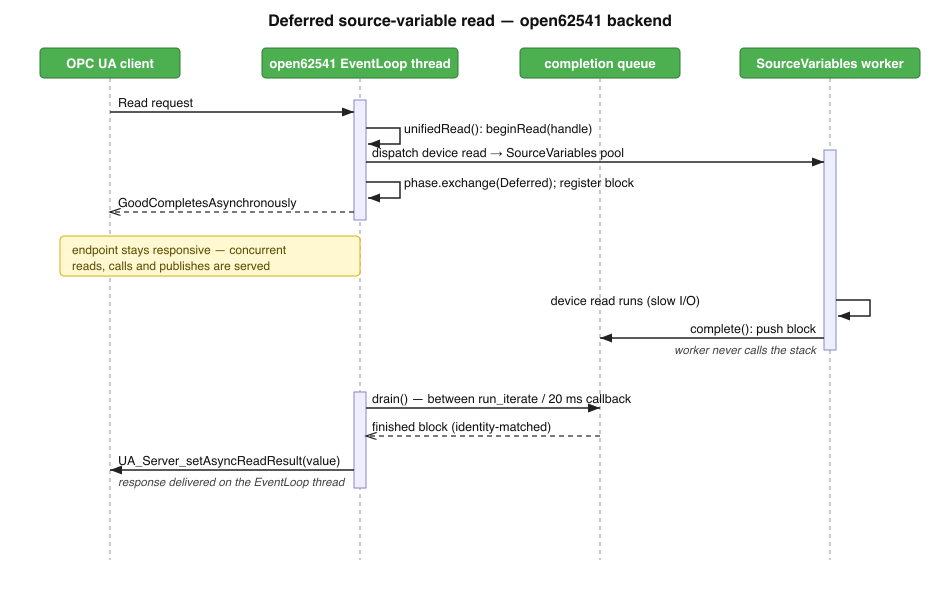
An OPC UA client issues a Read. The stack calls into the glue on the EventLoop thread;
unifiedReadallocates a block and callsbeginRead(handle).The source variable dispatches the device read to the SourceVariables worker pool and returns immediately.
The glue does
phase().exchange(Deferred). The worker has not finished, so it registers the block and returnsGoodCompletesAsynchronouslyto the client. The endpoint stays responsive – concurrent reads, calls and publishes are served on the EventLoop thread.The slow device read runs on a worker thread. When it finishes, the worker calls
complete(), which stores the value and pushes the block onto the completion queue. The worker never calls the stack.On the next drain (between
run_iteratecalls or on the 20 ms callback) the EventLoop thread pops the block, confirms the registry entry matches by identity, and callsUA_Server_setAsyncReadResult. The response is delivered to the client on the EventLoop thread.
quasar integration and the flavor matrix
quasar dispatches device work through a single process-wide worker pool –
Quasar::ThreadPool, the SourceVariables thread pool – created once at
startup by Meta’s DSourceVariableThreadPool and fetched everywhere via
SourceVariables_getThreadPool(). Both back-ends share this one pool.
Dispatch policy is driven by Design.xml attributes and is identical under both
back-ends: async-declared reads/writes/methods queue to the pool and run on a
worker; sync-declared ones run inline in the calling thread. For source
variables a configured mutex is held while the device delegate runs (inline
for sync, inside the worker for async) so serialization matches regardless of
synchronicity or back-end. Synchronous methods do not lock the configured
method mutex (addressSpaceCallUseMutex applies to asynchronous handlers);
this too is identical on both back-ends.
This mirrors the UA SDK IoManager job model directly. Under the UA SDK, I/O
reaches ASSourceVariableIoManager, which calls
SourceVariables_spawnIoJobRead/Write; that constructs a generated
IoJob (a Quasar::ThreadPoolJob) and either runs job.execute()
inline (synchronous job ids) or hands it to
sourceVariableThreads->addJob(...) (asynchronous job ids). The open62541
back-end reimplements the same contract in
ASSourceVariable::beginRead/beginWrite: it builds an equivalent work lambda
and either runs it inline under the optional mutex (sync) or dispatches it via
SourceVariables_getThreadPool()->addJob(work, description, mutex) (async).
The async-method handler in the generator is not guarded by back-end – it
compiles identically for both and dispatches to the same pool. Cache variables
are pure in-memory address-space state with no device dispatch and no pool
under either back-end.
Node flavor |
UA SDK |
open62541 |
|---|---|---|
Cache variable |
In-memory address-space access; no dispatch, no mutex, no pool. |
Same: in-memory, no dispatch. |
Source variable, async |
|
|
Source variable, sync |
|
Work lambda run inline in the calling thread, under
|
Method, async |
Generator handler (unguarded) dispatches via
|
Identical code path, same pool, same mutex selection. |
Method, sync |
Device call runs inline in the call thread. |
Identical: inline in the call thread. |
Every cell is behaviorally identical across the two back-ends. Async source-variable and async method work share the one SourceVariables pool.
Behavioural notes
Timestamps
The deferred read path preserves the requested TimestampsToReturn policy:
the merge into the target data value polices timestamps on the deferred path
while the inline path leaves them as produced. The UaDataValue constructor
orders source before server, so source and server timestamps land in the
correct fields on both back-ends.
Monitored items and publishing
Because deferred completions are issued on the EventLoop thread and the worker never touches the stack, sampling, subscription and publish are unaffected by a slow device read: while one operation is in flight on a worker, the EventLoop thread continues to service other sessions, monitored items and publish requests. This is the observable difference the async work delivers – a slow device no longer freezes the endpoint.
Synchronous-methods asymmetry
The deferral seam (handlesIo / beginRead / beginWrite) is for
source variables only. Methods always allocate a block and go through
beginCall, but a synchronous method still runs its device body inline in
the call thread under both back-ends – only async-declared methods are
dispatched to the pool. The block machinery is uniform; the synchronicity is
decided by the Design, not by the seam.